Sorting and Searchingexplained at five levels
One professor, one shuffled hand of eight numbered cards, five audiences. A child drags cards into order; a teenager counts the comparisons; an undergraduate drives the algorithms in notation; a PhD student fits a growth curve to live timings; a peer argues about branch mispredictions and skewed pivots.
- 1A childage seven
- 2A teenagercurious, some code
- 3An undergradcomputer science
- 4A PhD studentalgorithms
- 5A peeralgorithms researcher
Preview
5 levels
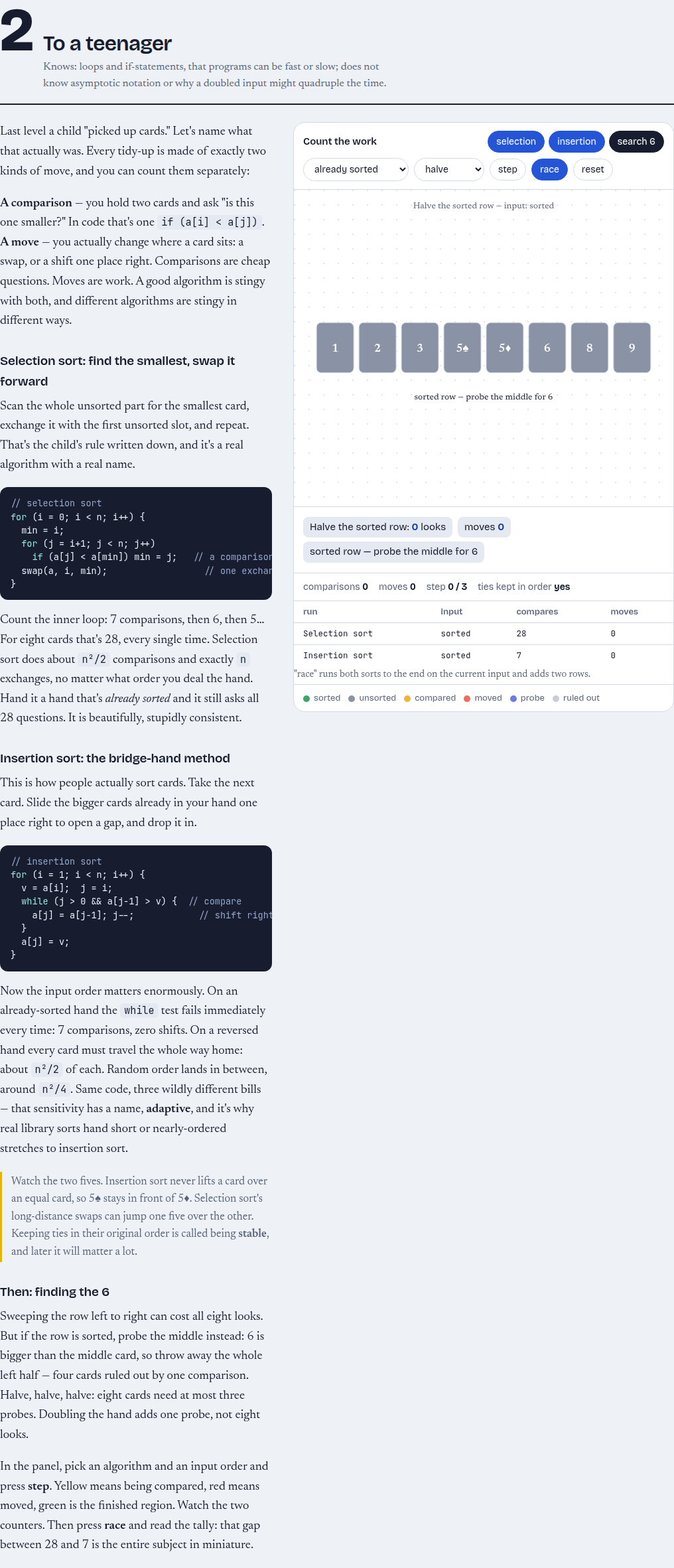
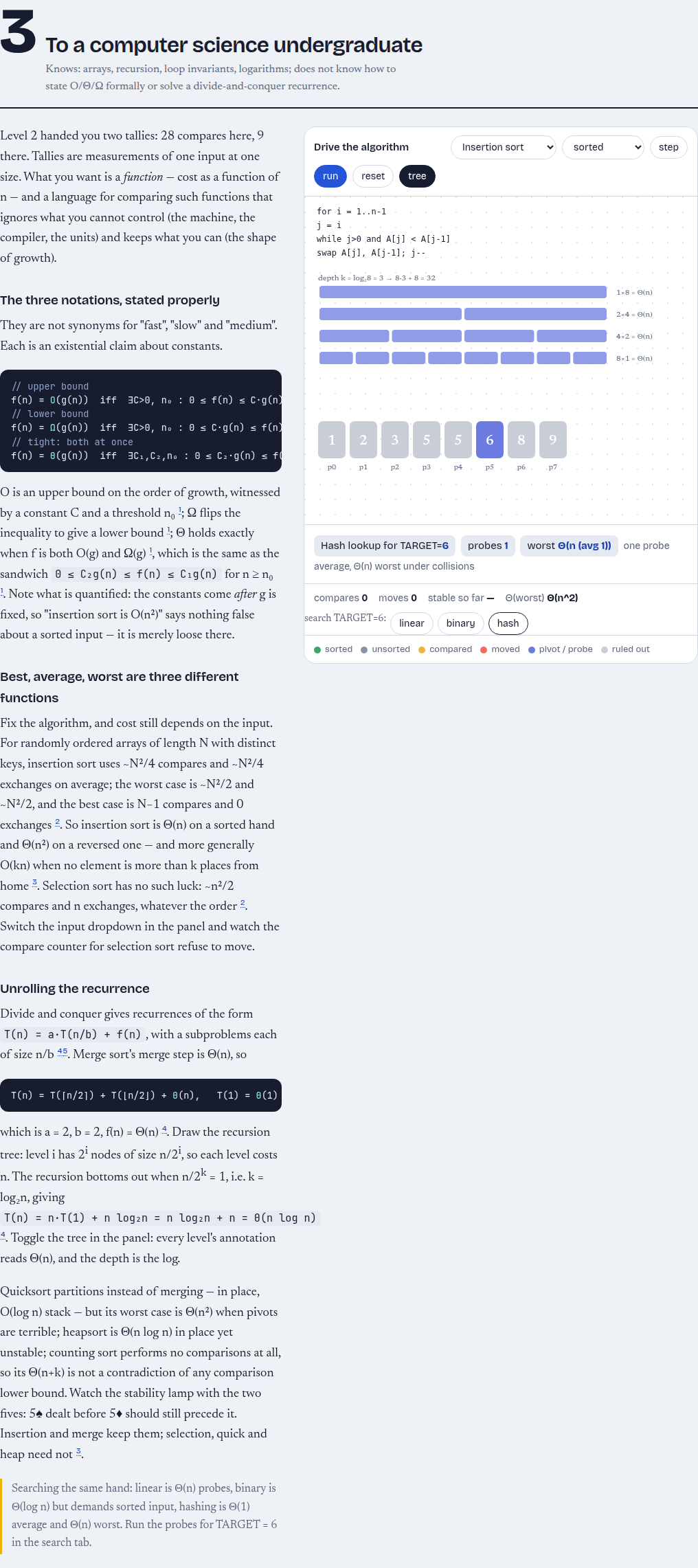
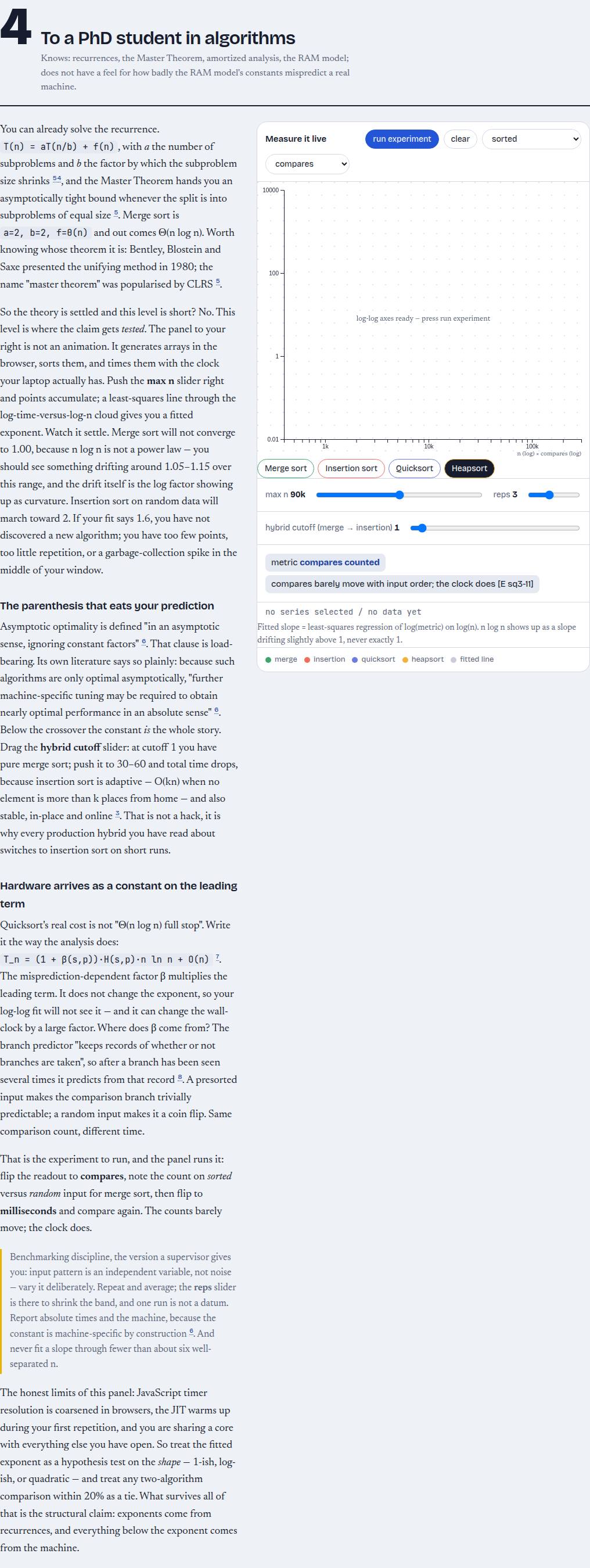
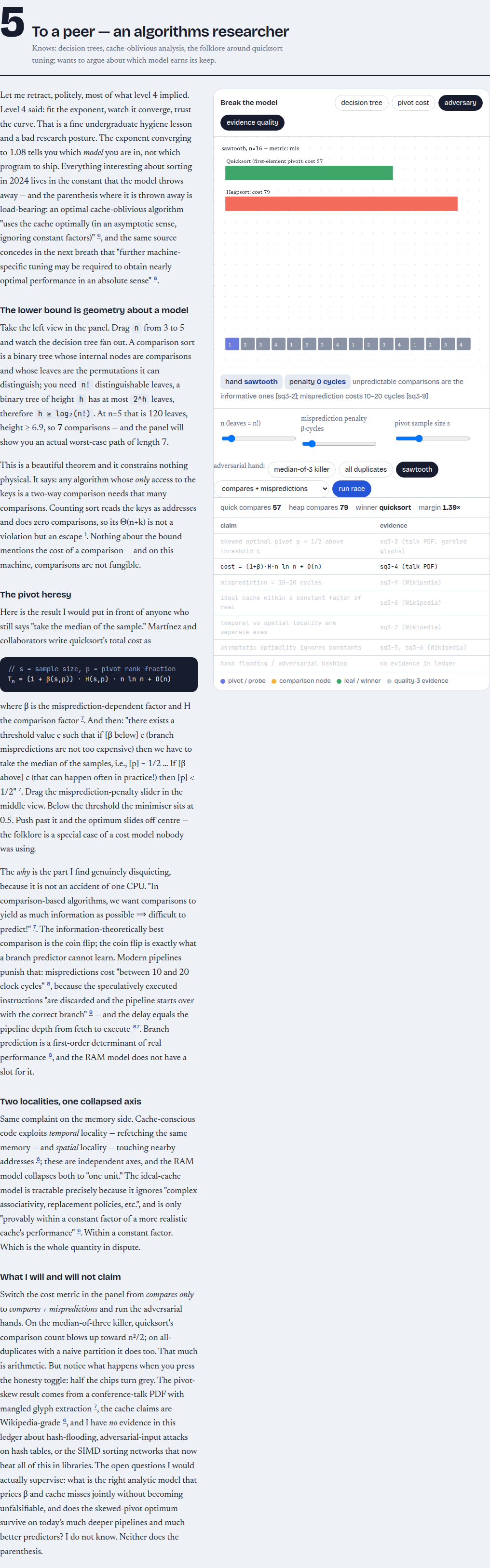
Sources
8 sources- 1.Big O vs Theta Θ vs Big Omega Ω Notations - GeeksforGeeksevidence sq2-5, sq2-6, sq2-7, sq2-8
- 2.Elementary Sortsevidence sq1-4, sq1-2
- 3.Insertion sort - Wikipediaevidence sq1-8
- 4.Solving Recurrencesevidence sq2-11, sq2-9, sq2-10
- 5.Master theorem (analysis of algorithms) - Wikipediaevidence sq2-4, sq2-3, sq2-2, sq2-1
- 6.Cache-oblivious algorithm - Wikipediaevidence sq3-5, sq3-6, sq3-7, sq3-8
- 7.Branch Mispredictions in Quicksortevidence sq3-4, sq3-3, sq3-2, sq3-1
- 8.Branch predictor - Wikipediaevidence sq3-11, sq3-9, sq3-10, sq3-12
Verification
20 claimsEvery material claim in the prose was checked against the evidence ledger by an independent verifier pass: 4 partial, 16 supported.
| Claim | Verdict | Note |
|---|---|---|
| For randomly ordered arrays of length N with distinct keys, insertion sort uses ~N²/4 compares and ~N²/4 exchanges on average; the worst case is ~N²/2 and ~N²/2, and the best case is N−1 compares and 0 exchanges | supported | sq1-4 states verbatim the average ~N²/4 compares/exchanges, worst ~N²/2, best N-1 compares and 0 exchanges. |
| Selection sort has no such luck: ~n²/2 compares and n exchanges, whatever the order | partial | sq1-2 gives ~n²/2 compares and n exchanges, but says nothing about being independent of input order ('whatever the order'). |
| Insertion sort is more generally O(kn) when no element is more than k places from home | supported | sq1-8 states time complexity is O(kn) when each element is no more than k places from its sorted position. |
| Insertion sort is adaptive — O(kn) when no element is more than k places from home — and also stable, in-place and online | supported | sq1-8 lists adaptive with O(kn), stable, in-place, and online. |
| Insertion and merge sort keep ties in original order (stable); selection, quick and heap need not | partial | sq1-8 supports insertion sort's stability only; nothing about merge sort's stability or the non-stability of selection, quick, and heap sort. |
| O is an upper bound on the order of growth, witnessed by a constant C and a threshold n₀ | supported | sq2-5 defines O as an upper bound on order of growth with positive constants C and n0. |
| Ω flips the inequality to give a lower bound | supported | sq2-6 defines Ω as a lower bound with the inequality 0 <= Cg(n) <= f(n). |
| Θ holds exactly when f is both O(g) and Ω(g) , which is the same as the sandwich 0 ≤ C₂g(n) ≤ f(n) ≤ C₁g(n) for n ≥ n₀ | supported | sq2-7 defines Θ as both O and Ω, and sq2-8 gives the sandwich inequality with C1, C2 for n >= n0. |
| Divide and conquer gives recurrences of the form T(n) = a·T(n/b) + f(n), with a subproblems each of size n/b | supported | sq2-11 gives the form T(n)=aT(n/b)+f(n) for divide-and-conquer and sq2-4 explains a as the number of subproblems and b as the size-reduction factor. |
| Merge sort's recurrence T(n) = T(⌈n/2⌉) + T(⌊n/2⌋) + Θ(n), T(1) = Θ(1) is a = 2, b = 2, f(n) = Θ(n) | partial | sq2-9 gives the recurrence with Θ(1) at n=1 and Θ(n) merge cost, but does not itself state the identification a=2, b=2, f(n)=Θ(n). |
| The recursion bottoms out when n/2^k = 1, i.e. k = log₂n, giving T(n) = n·T(1) + n log₂n = n log₂n + n = Θ(n log n) | supported | sq2-10 states the recurrence becomes trivial when n/2^k=1, k=log2 n, T(n)=nT(1)+n log2 n = n log2 n + n, and Θ(n log n). |
| The Master Theorem hands you an asymptotically tight bound whenever the split is into subproblems of equal size | supported | sq2-3 says the master theorem always yields asymptotically tight bounds for divide-and-conquer recurrences partitioning input into subproblems of equal sizes. |
| Bentley, Blostein and Saxe presented the unifying method in 1980; the name "master theorem" was popularised by CLRS | supported | sq2-2 credits Bentley, Blostein, Saxe (1980) with the 'unifying method' and CLRS with popularizing the name. |
| Asymptotic optimality is defined "in an asymptotic sense, ignoring constant factors" | supported | sq3-5 uses exactly the phrase 'in an asymptotic sense, ignoring constant factors' for optimality. |
| Because such algorithms are only optimal asymptotically, "further machine-specific tuning may be required to obtain nearly optimal performance in an absolute sense" | supported | sq3-6 contains the quoted sentence verbatim about further machine-specific tuning. |
| Quicksort's cost can be written as T_n = (1 + β(s,p))·H(s,p)·n ln n + O(n), where β is the misprediction-dependent factor and H the comparison factor | partial | sq3-4 shows T_n = (1+β(s,p))H(s,p) n ln n + O(n), but the quote does not define β as misprediction-dependent or H as the comparison factor. |
| The branch predictor "keeps records of whether or not branches are taken", so after a branch has been seen several times it predicts from that record | supported | sq3-11 says the predictor keeps records of whether branches are taken and bases prediction on recorded history after seeing a jump several times. |
| Martínez et al. state: "there exists a threshold value c such that if [β below] c (branch mispredictions are not too expensive) then we have to take the median of the samples, i.e., [p] = 1/2 … If [β above] c (that can happen often in practice!) then [p] < 1/2" | supported | sq3-3 contains the threshold statement matching the paraphrased quote with symbols elided as bracketed β and p. |
| Mispredictions cost "between 10 and 20 clock cycles" , because the speculatively executed instructions "are discarded and the pipeline starts over with the correct branch" — and the delay equals the pipeline depth from fetch to execute | supported | sq3-9 gives 10–20 cycles and the pipeline-depth equivalence, and sq3-10 gives the discard-and-restart mechanism. |
| The ideal-cache model ignores "complex associativity, replacement policies, etc.", and is only "provably within a constant factor of a more realistic cache's performance" | supported | sq3-8 mentions complex associativity, replacement policies, and being provably within a constant factor of a more realistic cache. |
How this was made
Researched by the Richards.AI deep research agent: the topic was scoped, decomposed into subquestions researched by parallel subagents into an append-only evidence ledger, written at five levels on one running example, audited by an independent claim-verification pass, and its interactive panels were exercised in a headless browser before publication.
- Preset
- quick
- Reason lane
- anthropic:claude-opus-5
- Verifier lane
- anthropic:claude-opus-5
- Evidence records
- 32
- Browser validation
- passed
- Prompt revision
- 4b9087b9e9c6 / 874deb875128